EXPLORE BOTSWANA & NAMIBIA WITH ROAM AND MORE
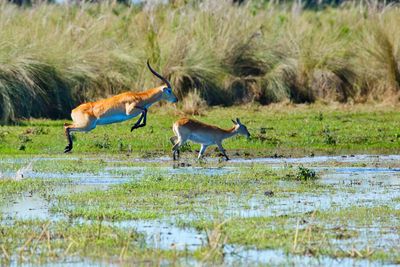
At 581,730 km2 (224,607 sq mi) Botswana is the world's 48th-largest country. The country is predominantly flat, tending toward gently rolling tableland. Botswana is dominated by the Kalahari Desert, which covers up to 70% of its land surface. The Okavango Delta, one of the world's largest inland deltas, is in the northwest. The Makgadikgadi Pan, a large salt pan, lies in the north.
Botswana has diverse areas of wildlife habitat. In addition to the delta and desert areas, there are grasslands and savannas, where blue wildebeest, antelopes, and other mammals and birds are found.
Northern Botswana has one of the few remaining large populations of the endangered African wild dogs. Chobe National Park, found in the Chobe District, has the world's largest concentration of African Elephants. The park covers about 11,000 km2 (4,247 sq mi) and supports about 350 species of birds.
The Chobe National Park and Moremi Game Reserve (in the Okavango Delta) are major tourist destinations. Other reserves include the Central Kalahari Game Reserve located in the Kalahari desert in Ghanzi District; Makgadikgadi Pans National Park and Nxai Pan National Park are in Central District in the Makgadikgadi Pan. Mashatu Game Reserve is privately owned: located where the Shashe River and Limpopo River meet in eastern Botswana. The other privately owned reserve is Mokolodi Reserve near Gaborone. There are also specialised sanctuaries like the Khama Rhino Sanctuary (for rhinoceros) and Makgadikgadi Sanctuary (for flamingos). They are both located in Central District.
At 825,615 km2 (318,772 sq mi), Namibia is the world's thirty-fourth largest country (after Venezuela).
Being situated between the Namib and the Kalahari deserts, Namibia has the least rainfall of any country in sub-Saharan Africa.
The Namibian landscape consists generally of five geographical areas, each with characteristic abiotic conditions and vegetation, with some variation within and overlap between them: the Central Plateau, the Namib, the Great Escarpment, the Bushveld, and the Kalahari Desert.
The Central Plateau runs from north to south, bordered by the Skeleton Coast to the northwest, the Namib Desert and its coastal plains to the southwest, the Orange River to the south, and the Kalahari Desert to the east. The Central Plateau is home to the highest point in Namibia at Konigstein elevation 2,606 metres (8,550 ft).
The Namib is a broad expanse of hyper-arid gravel plains and dunes that stretches along Namibia's entire coastline. It varies between 100 and many hundreds of kilometres in width. Areas within the Namib include the Skeleton Coast and the Kaokoveld in the north and the extensive Namib Sand Sea along the central coast.
The Great Escarpment swiftly rises to over 2,000 metres (6,562 ft). Average temperatures and temperature ranges increase further inland from the cold Atlantic waters, while the lingering coastal fogs slowly diminish. Although the area is rocky with poorly developed soils, it is significantly more productive than the Namib Desert. As summer winds are forced over the Escarpment, moisture is extracted as precipitation.
The Bushveld is found in north-eastern Namibia along the Angolan border and in the Caprivi Strip. The area receives a significantly greater amount of precipitation than the rest of the country, averaging around 400 mm (15.7 in) per year. The area is generally flat and the soils sandy, limiting their ability to retain water and support agriculture.
The Kalahari Desert, an arid region that extends into South Africa and Botswana, is one of Namibia's well-known geographical features. The Kalahari, while popularly known as a desert, has a variety of localised environments, including some verdant and technically non-desert areas. The Succulent Karoo is home to over 5,000 species of plants, nearly half of them endemic; approximately 10 percent of the world's succulent's are found in the Karoo. The reason behind this high productivity and endemism may be the relatively stable nature of precipitation.
Namibia's Coastal Desert is one of the oldest deserts in the world. Its sand dunes, created by the strong onshore winds, are the highest in the world. Because of the location of the shoreline, at the point where the Atlantic's cold water reaches Africa's hot climate, often extremely dense fog forms along the coast. Near the coast there are areas where the dunes are vegetated with hammocks. Namibia has rich coastal and marine resources that remain largely unexplored.
The country is a prime destination in Africa and is known for ecotourism which features Namibia's extensive wildlife. Namibia takes conservation really seriously, more than 40% of the country is under conservation management. It was the first African country to incorporate environmental protection into its constitution, hence its bountiful wildlife.
There are many lodges and reserves to accommodate eco-tourists. In addition, extreme sports such as sand-boarding, skydiving and 4x4ing have become popular, and many cities have companies that provide tours.The most visited places include the capital city of Windhoek, Caprivi Strip, Fish River Canyon, Sossusvlei, the Skeleton Coast Park, Sesriem, Etosha Pan and the coastal towns of Swakopmund, Wavlis Bay and Luderitz.
As this is a custom tailor made safari designed to the guest(s) specification, kindly contact us for full itineraries, availability and pricing.